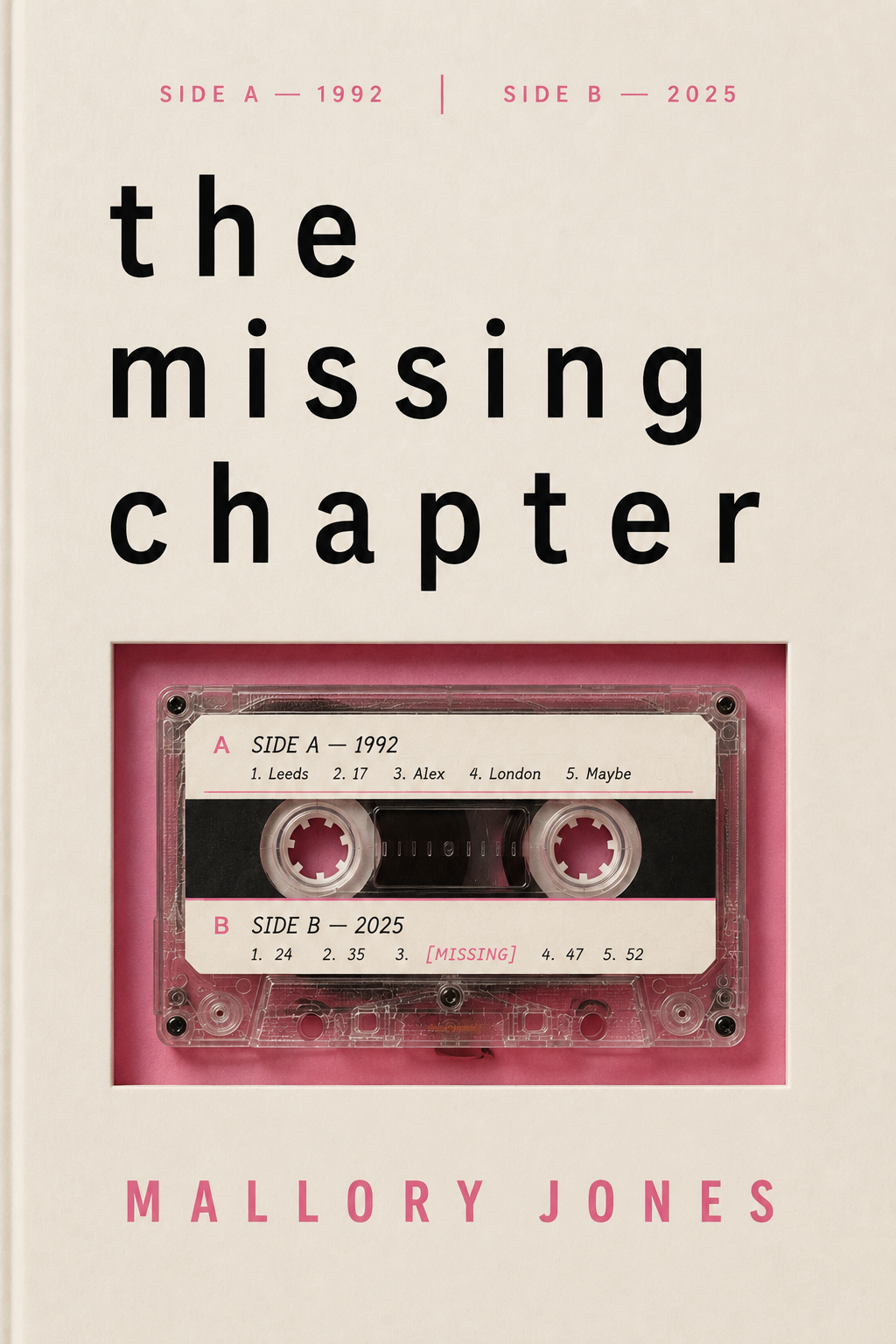
MALLORY JONES
The Missing Chapter
First love. Loud music. Trauma. Thirty years of unfinished business.
A novel about the people we were, the things we survived, and what happens when the past turns up again and says, “I loved you.”
About the Novel
Some stories don’t end. They just go quiet.
Freya and Alex were young, in love and completely unequipped for what happened to them. Then life moved on.
Thirty years later, they reconnect.
The Missing Chapter moves between early-1990s Leeds and the present day — through first love, friendship, sex, pregnancy, trauma, loss, music, memory and all the things two people managed not to say to each other.
Until now.
The Soundtrack to the Story
There are some memories you remember in pictures. Mine tend to arrive with a soundtrack.
The Missing Chapter grew up among mixtapes, record shops, gigs, Melody Maker and the music of early-90s Leeds. I’ll be sharing some of the songs, albums and musical rabbit holes that belong to Freya and Alex’s world.
Come Behind the Scenes
I’m writing about the novel, sharing excerpts, talking about the music and memories behind it, and documenting what happens when you write a book and then have to work out what the hell you’re supposed to do with it.
Watch the Story
I’m reading The Missing Chapter from the beginning, one chapter — and occasionally one slightly chaotic recording — at a time.
You can watch everything here, in the right order, without having to persuade an algorithm that you’d quite like to see Part Two.
WATCH FROM CHAPTER ONE →
Stories That Refuse To Behave
Stories That Refuse To Behave
Mallory Jones | The Missing Chapter
The Missing Footnotes: Before Everything Was Retrievable Leeds, 1989–93: the Phono, the Duchess, Nirvana, mixtapes, class, first love and the deeply unreliable archive of being young
Aug 29, 2026
https://malloryjonesthemissingchapter.substack.com/
There is a moment quite late in The Missing Chapter when Freya and Alex, now in their fifties and living on opposite sides of the world, start trying to remember which bands they saw when they were teenagers.
It begins harmlessly.
Gigs. Records. Books. Dogs. The general inventory of middle age.
Then somebody mentions the Duchess.
Do you remember the Duchess? Do you remember what’s-his-name with the coat?
This is safe territory. Or at least they think it is. Two people rummaging through an old photograph album together, except there is no photograph album. There are two memories, thirty-three years apart, neither of which can quite be trusted.
Earlier in the novel, seventeen-year-old Freya and nineteen-year-old Alex talk endlessly about going to the Duchess to see bands they cannot afford to see. Sometimes they actually make it. Decades later, they are still arguing by email about precisely which bands they had and had not seen there.
When I wrote that, I thought I was writing about them.
Then I started researching the Leeds music scene of my own youth and discovered that apparently I am no better.
I have confidently remembered Mudhoney as being in Leeds approximately every second Thursday for more than thirty years.
The archives would now like a word.
This is inconvenient when you have just written an entire novel partly about the unreliability of memory.
But perhaps it is also the point.
The Missing Chapter is a novel, not a memoir. Freya and Alex are fictional characters and the story belongs to them. But the cultural landscape they inhabit is informed by one I knew intimately.
I was there.
And it was fucking brilliant.
The first goth club in the world was underneath a shopping centre
Of course it was.
Not Berlin.
Not New York.
Not London.
Leeds. Underneath the Merrion Centre.
Le Phonographique — the Phono — began life as the WigWam before being renamed in 1979. It became a meeting place for Leeds’s post-punk and New Romantic scenes at precisely the point when those scenes were mutating into something darker. It is now widely described as the world’s first goth nightclub, predating London’s Batcave. Marc Almond DJ’d there. The Sisters of Mercy emerged from the same extraordinary Leeds ecosystem, and the club became one of the places where goth developed a recognisable identity. (Wikipedia)
There was a pillar in the middle of the dancefloor, which is apparently implicated in the development of that wonderfully economical goth dancing where everybody moves two steps forward and two steps back.
A global youth subculture partly shaped by inconvenient structural engineering.
That feels very Leeds.
The history of the Phono gets surprisingly untidy around the early nineties. Published chronologies describe closures, relocated nights, reopenings and changes of name. I can only give you the lived version: I worked behind the bar there in 1992–93, in the place we all called the Phono.
Which is perhaps worth noting in an essay about memory. Official histories like nice clean dates. People who actually occupied places are much less cooperative.
In The Missing Chapter, Freya remembers getting into the Phono through the bizarre entrance in the floor, heading down into a tiny underground room with a DJ in one corner, the bar in another, hideous toilets somewhere beyond and what may have been the stickiest carpet in Western Europe.
Most importantly, it was cheap.
You could make one pint last a very long time.
And if you were seventeen, skint and in love, that mattered. Freya and Alex stand near the speakers where they can feel the bass in their sternums, dance to a fairly indiscriminate mixture of goth, indie and garage, and snog each other’s faces off.
That scene isn’t there because I wanted to scatter some early-nineties nostalgia over the novel.
Places like the Phono did something.
They gave people somewhere to be.
Weird was practically an entry requirement
At the beginning of The Missing Chapter, Freya is seventeen, from a council estate and absolutely determined that education is going to get her somewhere else.
She arrives at college in an old man’s cardigan, battered Doc Martens, an army-surplus bag and a recently pierced nose.
She has spent most of her childhood feeling slightly too much of everything — too opinionated, too intense, too interested in politics, too inclined towards enormous words.
Then she gets to college and discovers something extraordinary.
Here, weird isn’t something to apologise for.
Weird is practically an entry requirement.
That mattered in the alternative scene too.
Doc Martens had begun as practical work boots before being successively adopted by British youth cultures — skinheads, punks, goths, psychobillies, grebos and others — until they became something approaching a uniform for people who didn’t particularly want a uniform. Dr Martens’ own history records that by the 1980s girls were buying and customising the classic boots, and that in the 1990s grunge carried them even further into the mainstream. (Dr Martens)
Then something deeply irritating happened to people who were already dressed like that.
On 24 September 1991, Nirvana released Nevermind.
By January 1992 it was number one in America. (Nirvana)
And suddenly the weird kids were fashionable.
Not entirely, obviously. Britain already had punk, goth, post-punk, grebo and indie cultures with their own versions of charity-shop clothes, enormous boots, uncooperative hair and deliberate resistance to looking conventionally presentable.
Nirvana did not invent that.
They merely caused everybody else to notice.
For those of us already wearing it, there was something faintly annoying about discovering that the clothes people had thought looked ridiculous six months earlier were now apparently an aesthetic.
We had not acquired an aesthetic.
We were skint.
The boots lasted.
There is a difference.
And Leeds had already been doing this for years
Manchester has done an absolutely magnificent job of telling everybody about Manchester.
Credit where it’s due.
Leeds, meanwhile, seems to have spent much of the same period standing at the back of the room in black, smoking, refusing to participate in its own publicity campaign.
There is now a serious argument that Leeds has been badly underrepresented in histories of British alternative music. Louder has gone as far as making the case that Leeds, not Manchester, was the true home of 1980s alternative music — partly provocative, obviously, but not completely absurd. Punk in Leeds rapidly fragmented into post-punk, goth, industrial, jangling indie, shoegaze, grebo, electronic music and several other things nobody could agree what to call. (Louder)
The city produced or nurtured Gang of Four, the Mekons, Delta 5, Soft Cell, the Sisters of Mercy, the Mission, the Wedding Present, Cud and Pale Saints.
At the slightly baggier end of things came the Bridewell Taxis, Leeds’s brass-assisted answer to the neighbouring Madchester explosion. At the electronic end there were LFO and Nightmares on Wax. A recent interview with Bridewell Taxis’ Michael Roberts remembers exactly that late-eighties/early-nineties moment: the Wedding Present, Cud, Pale Saints, LFO and Nightmares on Wax all part of a remarkably dense Yorkshire scene. (Louder Than War)
The point wasn’t that everyone liked the same music.
God, no.
Arguing about the music was part of the music.
Which is why Alex in The Missing Chapter can spend forty minutes explaining why everyone has misunderstood a song, become obsessed with a band for ten days, regard the folding of an NME as an act of vandalism, and then move seamlessly onto the Gulf War.
Music wasn’t background noise.
It was one of the ways people built themselves.
And then there was the Duchess
The Duchess of York was on Vicar Lane, with a capacity of only about 250. Its real peak as a grassroots music venue ran from the late eighties through the nineties, which puts it exactly inside the world Freya and Alex inhabit. Bands played there with extraordinary regularity, often before anybody outside small pockets of the country had the faintest idea who they were. It closed in 2000 and received a Leeds Civic Trust blue plaque in 2024. Music historian Brett Lashua has described it as Leeds’s most important grassroots concert venue. (Louder Than War)
Look at the names now and the list is ridiculous.
PJ Harvey.
Radiohead.
Blur.
Pulp.
The Verve.
Placebo.
Green Day.
Oasis. (We told them to go away)
Nirvana.
Oasis reportedly played there in 1993 to two paying customers, then returned the following year to rather more interest. (Louder Than War)
And on 25 October 1989, Nirvana played the Duchess.
Two years before Nevermind.
Kurt Cobain is reputed to have slept afterwards on a sofa upstairs. It is now literally mentioned on the blue plaque. (Louder Than War)
Which brings us, inevitably, to Stevie.
Stevie is one of the characters who carries some of this world into The Missing Chapter. Slightly older than Freya, she is regarded by the younger girls as practically a sexual anthropologist and attempts, with limited success, to broaden Freya’s education.
Stevie was our much-respected sexual adventurer.
And she had absolutely no shame about any of it.
I don’t mean no shame in that peculiar judgemental way it has traditionally been applied to young women who enjoy sex. I mean she appeared genuinely to have rejected the premise that there was anything to be ashamed of.
She liked sex.
She pursued it enthusiastically.
She was entirely capable of reporting back afterwards.
At seventeen, I thought this was magnificent.
And Stevie’s contribution to the Duchess mythology was to have sex on the sofa on which Kurt Cobain had reportedly slept.
So music historians may remember the Duchess for nurturing some of the most important bands of the following decade.
Our group had additional cultural landmarks.
Kurt Cobain may have slept there. Stevie, characteristically, made better use of the furniture.
History is made by the people in the room.
The strange experience of seeing people before they were history
I was at the Nirvana/L7 gig at Leeds Polytechnic on 25 October 1990.
That one I can now prove existed, which is always reassuring.
The bill included ARM, L7, Victims Family and Nirvana. Live Nirvana’s archive records them already playing songs including Lithium, Breed and In Bloom. One surviving piece of amateur footage was actually filmed from the side of the stage by a member of L7. (Live Nirvana)
This was eleven months before Nevermind.
I have also got memories of Pop Will Eat Itself, the Lemonheads, Blur, the Sugarcubes — Björk before the word Björk meant quite what it means now — and possibly Alien Sex Fiend.
Possibly.
I’m keeping the possibly.
Because this is where things become interesting.
Some of the archive agrees beautifully with me.
The University of Leeds archive records the Sugarcubes on 16 October 1989, Pop Will Eat Itself on 31 October 1990, and Ned’s Atomic Dustbin on 3 November 1990 and again on 15 March 1991. (University of Leeds)
The Lemonheads played the Duchess on 2 April 1991, with Kingmaker. (Concert Archives)
Blur played the Duchess on 8 November 1990. Graham Coxon later remembered Damon Albarn announcing that they were from London, only for someone in the Leeds audience to suggest, with characteristic hospitality, that they return there. (Damon Albarn Unofficial Archive)
And Ned’s Atomic Dustbin really did keep appearing: as well as those university dates, there is a recorded Duchess gig on 16 March 1990. (Concert Archives)
Which raises the possibility that my thirty-year conviction that Mudhoney were forever playing Leeds may actually be a misfiled Ned’s Atomic Dustbin memory.
Or there are missing listings.
Or I saw Mudhoney elsewhere.
Or all three.
Memory: excellent atmosphere. Terrible filing system.
Before everything was retrievable
This is the part I think is hardest to explain now.
You couldn’t look anything up.
That sounds obvious, but it altered the structure of being young.
Music arrived weekly.
In print.
NME. Melody Maker. Fanzines.
You queued for things.
You discovered that a band was playing because somebody told you, because you saw a flyer, because the NME listed it, or because you went into a record shop and found a little cardboard ticket on sale.
Crash Records opened in Leeds in 1985 and moved to the Headrow in 1987. It specialised in exactly the sort of indie, alternative, punk and rock that mattered to this scene and acted as a ticket agent for local gigs. (Crash Records)
In The Missing Chapter, Freya and Alex make a regular circuit of Crash and Jumbo.
Freya has two jobs. Most of the money disappears almost immediately into the all-important record or gig ticket because, as she later understands, she wasn’t working only to survive.
She was working to live.
There was no algorithm.
There was a man behind a counter who looked faintly disappointed by your taste.
I’m not entirely convinced we’ve improved on this system.
And if John Peel played something on the radio and you wanted it, you put a blank cassette into the machine and sat with your finger poised over pause.
You tried to catch the beginning.
You failed.
The DJ talked over the intro.
You swore.
And then you listened to that slightly mutilated version for the next four years.
A mixtape wasn’t a playlist
It was correspondence.
You needed the records.
You had to record the songs in real time.
You had to work out the order.
You had to make sure the final track fitted on the remaining tape.
You wrote the track listing by hand.
And if the tape was for somebody you loved, the songs did some of the speaking.
This is why the mixtapes matter in The Missing Chapter. Alex makes them for Freya early in their relationship. They aren’t grand romantic declarations. His instructions are more along the lines of:
SIDE B IS BETTER.
TRACK 4. JUST TRACK 4.
They are funny and bossy and completely him.
But thirty-three years later Freya understands something about those objects that she couldn’t have understood at seventeen: a boy who couldn’t communicate would not spend an entire evening choosing songs and writing tiny instructions on an inlay card.
The object was part of the conversation.
A playlist is certainly easier.
But nobody has ever handed me a Spotify link and made me think: This person just gave me six hours of their Saturday.
You had to be there
That is perhaps the biggest difference.
Nothing was automatically preserved.
If you missed the gig, you missed it.
If you weren’t in the room, you didn’t know exactly what had happened there.
If somebody said something to you in 1991, there was generally no searchable record of the conversation.
There was no photograph unless somebody had a camera.
There was no endless stream of video proving that you had attended.
There was you.
And whoever else remembered.
That’s why The Missing Chapter keeps returning to physical things.
Boots.
Tapes.
Books.
Handwriting.
Rooms.
The particular smell of wet pavement.
The noise of a train going over the Dark Arches.
Objects sometimes survive where narrative doesn’t.
And music has the unnerving ability to preserve something the conscious mind has thrown away.
Freya describes an album from that winter as almost surgical in its ability to put her back in Alex’s room. She eventually learns that she can listen to it again without needing to run away from the memories.
That’s memory in The Missing Chapter.
Not a recording.
A trigger.
The future was opening as well
The musical landscape wasn’t the only thing changing.
Higher education was expanding at extraordinary speed.
In Great Britain, the proportion of young people entering full-time higher education rose from about 15% in 1988 to 23% in 1991 and 28% in 1992. (UK Parliament)
But class still determined very strongly whether university felt like a natural destination.
In 1991, the age participation rate among young people from professional, intermediate and skilled non-manual social classes was about 35%.
Among skilled-manual, partly-skilled and unskilled groups it was 11%. (UK Parliament)
That difference sits underneath one of my favourite tiny exchanges in the first part of the novel.
Freya and Alex walk past the university.
He talks about the following year.
She asks whether he thinks they’ll get in.
He says he has never really considered that they won’t.
Freya has.
And adult Freya eventually understands the whole class distinction inside that exchange:
He wasn’t being naive. He was being loved.
Alex has grown up assuming the future will arrive.
Freya has spent her childhood constructing an escape route towards it.
For people from families where nobody had gone to university, this was an extraordinary historical moment.
The door was opening.
But not everybody standing outside it had yet been taught that they were allowed to walk through.
This is why the music isn’t just decoration
The first part of The Missing Chapter is, on the surface, a first-love story.
Freya meets Alex.
They fall absurdly, completely in love.
They spend their days in bookshops, record shops, cafés, buses, graveyards and bedrooms.
They are skint.
They make a world anyway.
There is enormous freedom in it.
Music, books and education are all part of the same thing: the belief that there is somewhere else to go.
And then, at the end of Chapter Three, biology arrives.
Freya realises she may be pregnant.
Suddenly the future she has been building since childhood looks as though it may disappear.
That’s the point where the social history matters.
A seventeen-year-old girl from a council estate getting pregnant in 1992 isn’t only dealing with pregnancy.
She’s looking at the statistical gap between the future she has imagined and the future she has watched happen to women around her.
And Alex, who has loved her into believing another world is possible, cannot understand that fear in quite the same way because he has never had to.
So the gigs, the Docs, the college, the books, the Phono, the university aren’t decorative period details.
They are the architecture of Freya’s imagined escape.
It wasn’t all Leeds
There was a wider looseness to the culture as well.
Glastonbury in 1992 officially had around 70,000 people and a ticket cost £49. (Glastonbury Festivals)
This was still the era in which festival boundaries could be interpreted with a degree of creativity.
There were years when climbing a fence into Glastonbury seemed, culturally at least, to occupy a category somewhere between criminal trespass and extracurricular activity.
I am not claiming Michael Eavis officially endorsed this.
His perimeter fence may have held another view.
But it belonged to a broader period when youth culture felt less managed.
Less recorded.
Less immediately monetised.
Sometimes considerably less safe.
But also, occasionally, gloriously improvised.
Thirty-three years later, Google enters the relationship
And this is where the story folds back on itself.
When Freya and Alex begin corresponding again in their fifties, they start with safe material.
Gigs.
Books.
Work.
Children.
Dogs.
Then 1992 creeps in.
Do you remember this?
And their memories begin acquiring colour again.
This is one of the things I find most interesting about them.
Alex can remember a shirt Freya wore on one particular afternoon more than three decades earlier.
Yet elsewhere in the novel, an old friend reminds him about a gig they attended together and Alex has no memory of it at all.
He knows he must have been there.
Nothing comes back.
His own explanation is that he shut that entire period down — not just Freya, but pieces of the year around her: gigs, friendships, records, good memories disappearing with the unbearable ones.
And yet he remembers the shirt.
Both things are true.
That may be my favourite thing about memory.
It has absolutely no respect for what you think ought to be important.
A date?
Gone.
A significant conversation?
Possibly reconstructed from three incompatible fragments.
Who played the Duchess?
We’ll be arguing about it at fifty-two.
The colour of somebody’s shirt on an ordinary afternoon in 1992?
Crystal clear.
The archive can tell you what happened. It cannot tell you what it meant.
This is the strange advantage we have now.
I can type a date into a computer and discover that Nirvana played Leeds Polytechnic on 25 October 1990.
I can find the set list.
I can discover L7 were there.
I can find out that the Sugarcubes played Leeds University on 16 October 1989 and that Pop Will Eat Itself played there on Halloween the following year.
I can verify that Ned’s Atomic Dustbin really were in Leeds with suspicious frequency.
The archive can settle an argument.
What it cannot tell me is what the room felt like.
It cannot tell me who I was standing beside.
It cannot tell me whether I had enough money for another drink.
It cannot tell me whether somebody kissed me afterwards.
It cannot tell me what it meant to be fifteen or seventeen or eighteen, standing in a dark room in northern England listening to a band who had not yet become important.
Because none of us knew they were important.
That is the part nostalgia gets wrong.
We did not walk around Leeds thinking we were living through an era.
We were waiting for buses.
We were skint.
We were smoking.
We were falling in love with completely unsuitable people.
We were making terrible decisions.
We were wearing boots that hurt for the first six months.
We were arguing about whether a band had sold out before they had sold enough records for selling out to be commercially meaningful.
We were trying to get into university.
We were trying to get out of houses.
We were trying to find somewhere warm.
We were trying to become people.
And every so often we accidentally wandered into a room containing somebody who would later become part of music history.
It was amazing to be young and alive then
I don’t mean better.
That distinction matters.
A great many things about being young in the early nineties were objectively worse.
Information was difficult to get.
Sexual-health provision could be humiliating.
Mental-health care was appalling.
Class barriers were enormous.
Young women were still subjected to standards about sexuality that young men could cheerfully ignore.
Being queer could be dangerous.
Somebody could disappear from your life and you genuinely might never find them again.
There was no mobile phone in your pocket if you needed help.
I am not interested in pretending otherwise.
But there was something about scarcity that gave objects, places and encounters extraordinary weight.
The record you finally managed to buy mattered.
The ticket mattered.
The tape mattered.
The club mattered.
The person who handed you the tape mattered.
And if home wasn’t somewhere you particularly wanted to be, a scene wasn’t simply entertainment.
It could be a place where you were permitted to construct another self.
Where weird wasn’t something to apologise for.
Where a girl from a council estate could stand in enormous boots, argue about politics, listen to something nobody else she knew had heard yet, and think:
There might be more than this.
That is the Leeds I wanted underneath the first half of The Missing Chapter.
Not a nostalgia filter.
A world.
A world in which Freya and Alex could find each other.
A world they would lose.
And a world that, thirty-three years later, they would begin trying to rebuild in emails from opposite sides of the planet, one half-remembered gig at a time.
Perhaps that is why I don’t mind that we can’t agree on all of them.
Memory isn’t an archive.
It doesn’t preserve everything.
It preserves what it can.
The Phono becomes a sticky carpet and bass in your sternum.
The Duchess becomes bands you may or may not have seen and a sofa with an increasingly distinguished sexual history.
Nirvana becomes a night that only became historic afterwards.
A mixtape becomes handwriting.
A pair of Doc Martens becomes the person you were when you could still walk everywhere in them.
A song becomes a room.
And sometimes, decades later, somebody says three words and the whole bloody thing starts playing again.
Sources and excellent Leeds rabbit holes
The Duchess, Leeds — Yorkshire Post — Duchess history, Oasis and the Cobain sofa.
The Duchess receives a blue plaque — Louder Than War — the 2024 plaque, venue history and Brett Lashua’s comments.
Le Phonographique — history and chronology — useful particularly for the Phono’s complicated changes of name/ownership.
The Merrion Centre and the first goth nightclub — Far Out — the Phono and the emergence of Leeds goth.
Forget Manchester: Leeds was the real home of 80s alternative music — Louder — a wonderfully provocative overview of the wider Leeds scene.
Bridewell Taxis interview — Louder Than War — particularly good on the density of the Yorkshire scene around the turn of the decade.
University of Leeds live music archive — invaluable for the did I actually see them or have I invented this? stage of middle age.
Nirvana at Leeds Polytechnic, 25 October 1990 — the Nirvana/L7 bill and surviving performance details.
Crash Records — shop history — Leeds record-shop history and the ticket-buying culture.
Glastonbury 1992 — official festival history — 70,000 people, £49 tickets and an entirely different festival universe.
https://degeroatque296025.substack.com/p/ffb06b3a-a8c1-4940-9eca-299854ea9a13?postPreview=free&updated=2026-08-29T02%3A16%3A22.060Z&audience=everyone&free_preview=false&freemail=true
I Wrote a Novel in Two Weeks. Unfortunately, That Was the Easy Bit.
On noisy fictional people, unreliable memory, accidental BookTok, thirty-three years rearranging themselves, and discovering that apparently I am a novelist now.
There was no beautiful notebook.
No writing retreat.
No five-year plan involving character arcs, index cards and a tasteful shed at the bottom of the garden.
I received three words.
I loved you.
And apparently my response to this perfectly manageable piece of information was to write approximately 43,000 words in a week.
A week after that, I had around 78,000.
This is not normal behaviour.
Even I know that.
At some point during the second week, I looked at the thing on my laptop and realised, with some alarm, that it had acquired chapters.
There were characters.
There was structure.
There were recurring motifs.
There appeared to be a plot.
I had accidentally made a book.
And for approximately twelve minutes I thought:
Well. That was surprisingly easy.
Reader, it was not.
Writing the book took two weeks. Writing the book has taken considerably longer.
The thing that arrived in those first two weeks was the shape of The Missing Chapter.
And I remain slightly astonished by how complete that shape was.
It was almost as though the story had been sitting somewhere behind me for years, arms folded, tapping its foot, waiting for me to finally notice it.
Once I did, it came out at speed.
I wrote everywhere.
I wrote too late.
I wrote when I should have been doing other things.
I woke up knowing what came next.
I wrote scenes before I understood why they belonged there.
I wrote things and then thought:
Oh.
And occasionally:
Oh, fuck.
But there is an important distinction between having 78,000 words and having a novel.
The first requires a keyboard and an alarming degree of hyperfocus.
The second requires work.
So much fucking work.
Moving scenes.
Moving them back.
Deleting things.
Restoring things I had triumphantly deleted three days previously.
Discovering that a perfectly good paragraph was sitting in completely the wrong chapter.
Taking out explanatory sentences because the scene already did the work.
Putting one back because apparently the scene did not do quite as much work as I thought.
Realising that I had said the same thing three times.
Realising that I had said something important no times at all.
Checking dates.
Checking ages.
Checking whether something could actually have happened on a Thursday.
Developing opinions about em dashes that I did not know a human being could possess.
Writing fast gave me the shape.
Editing gave me the story.
And then there were the characters.
Nobody warned me that fictional people are such demanding bastards
This may be obvious to experienced novelists.
It was not obvious to me.
I thought I was in charge.
I had, after all, made these people up.
That seems, superficially at least, like quite a strong managerial position.
It isn’t.
Freya arrived first and immediately developed opinions.
Alex followed shortly afterwards and was considerably worse.
The problem with characters becoming properly alive is that they start objecting when you make them do things for the convenience of the plot.
You write a sentence.
Something in your head says:
He wouldn’t say that.
Excuse me?
I literally invented him.
Apparently irrelevant.
Delete.
Try again.
Or you decide a scene would be neater if Freya were slightly more reasonable.
Freya has absolutely no interest in being slightly more reasonable.
She is angry.
She’s funny.
She’s unfair sometimes.
She swears.
She notices things you’d rather she didn’t.
She refuses to deliver a tasteful piece of literary self-awareness simply because it would make the paragraph easier to finish.
And eventually I realised that this was a good sign.
The moment I stopped asking:
What do I need these characters to do?
and started asking:
What would these people actually do?
the book got better.
More inconvenient.
But better.
First-time-author lesson number one:
Apparently fictional people are very bossy.
Then memory started misbehaving
This would already have been an interesting problem in any novel.
It is particularly inconvenient when you have written a book in which memory is one of the central subjects.
Because while Freya and Alex were busy trying to work out what they remembered from thirty-three years earlier, I began investigating my own memories of the world that informs theirs.
Leeds.
The Phono.
The Duchess.
Record shops.
Bands.
Gigs.
Mixtapes.
The strange little alternative ecosystem we inhabited at the beginning of the 1990s.
And I discovered something irritating.
Memory is excellent at atmosphere and absolutely shit at administration.
I can remember the smell of a room.
I can remember what somebody’s hand felt like.
I can remember wet pavement, bus heaters and Doc Martens.
I can remember standing in a club with the bass somewhere behind my sternum.
Ask me which band played which venue on which Thursday in 1991?
Apparently my brain has filed that information under:
LOUD. LEEDS. PROBABLY BRILLIANT.
For decades I have confidently remembered Mudhoney as playing Leeds approximately every other Thursday.
The gig archives are rather less convinced.
Meanwhile, other bands keep appearing in the listings with suspicious regularity.
This has led to the deeply humbling experience of sitting at a computer in my fifties thinking:
Bloody hell. Alex and Freya aren’t the unreliable ones. I am.
Which is, of course, precisely what the novel is interested in.
Memory does not preserve a life like CCTV.
It preserves fragments.
Some are ridiculously clear.
Some are missing entirely.
Some have been quietly moved into the wrong folder.
And some can be returned to you decades later by another person who says:
Don’t you remember?
Sometimes you do.
Sometimes you don’t.
Sometimes the fact that they remember becomes more interesting than the memory itself.
One thing happened. Then fiction got involved.
This is the bit I find hardest to explain when people ask where The Missing Chapter came from.
Because the answer is both very simple and not simple at all.
The novel began with something real.
Three words.
Something from the past suddenly looked different.
That was the spark.
But a spark is not a novel.
Freya is not me.
Alex is not a transcription of another person.
The events of the novel belong to the novel.
Real experience gave me certain emotional questions.
Fiction gave me somewhere to take them.
What happens when the explanation you have carried for decades suddenly stops working?
What happens when two people remember the same relationship differently?
What happens when love and harm are both true?
What happens when somebody finally gives you the information you thought you had needed for thirty-three years — and then disappears before you can have the conversation that information creates?
And, perhaps most importantly:
What happens after?
That is where the book became more interesting to me than the event that triggered it.
I stopped trying to explain something that had happened.
I started following Freya.
That was the point at which it became a novel.
Meanwhile, my actual life apparently objected to being left out
All of this would have been quite enough.
Instead, while I was editing a novel about memory, first love, identity, silence and the stories we build our lives around, my own thirty-three-year relationship began rearranging itself.
Because apparently subtlety is not something the universe is particularly interested in.
There is a peculiar experience involved in editing a fictional woman’s understanding of her life while simultaneously looking around your own and thinking:
Well, this is awkward.
I don’t mean that the book caused anything.
Life is rarely that narratively convenient.
But writing has a nasty habit of making evasion slightly more difficult.
You spend hours asking a character:
But what do you actually want?
Then you close the laptop.
And unfortunately the question is still in the room.
You write about somebody recognising the difference between endurance and happiness.
Then you go and make a cup of tea.
The sentence follows you into the kitchen.
Very rude.
So while The Missing Chapter was being moved around on my screen — paragraphs shifting, chapters finding their correct places, things I thought were fixed becoming unfixed — something much larger was shifting outside it.
Thirty-three years is a lot of life.
You do not rearrange it neatly.
There are no chapter breaks.
Nobody inserts *** and moves you elegantly into the next scene.
Mostly there are boxes.
Administrative emails.
Moments when your house feels completely unfamiliar.
Moments when it suddenly feels like yours.
Grief arriving at deeply inconvenient times.
And the rather surreal experience of continuing to argue with fictional people while your own life is sitting behind you going:
Excuse me, I think you’ll find I have notes.
And then, for reasons I still don’t entirely understand, I joined TikTok
This may have been where things really got out of hand.
Having accidentally written a novel and then made the objectively questionable decision to send it to literary agents, I decided that what I obviously needed next was to learn social media.
At fifty-two.
From scratch.
Excellent.
I knew almost nothing about TikTok.
I knew slightly more about Instagram, which is to say I knew there were photographs.
Suddenly I was learning about vertical video.
Hooks.
Watch time.
Captions.
Static posts.
Reels.
Whether nine minutes is completely insane.
Where to put text so TikTok doesn’t put a button over it.
Why my face is enormous.
Why the sound is tiny.
Why the dogs apparently believe the phrase “Chapter One” means “begin barking immediately.”
There are teenagers running multinational personal brands from their bedrooms while doing their GCSEs.
Meanwhile I have spent forty-five minutes trying to work out why Instagram has cut the bottom off a picture.
Humbling.
And yet something quite lovely has happened.
People started watching.
Then some of them stayed.
Then they followed.
Then they commented.
They began talking about Freya and Alex as though they knew them.
Which is astonishing.
Because until very recently these people existed only in my head and in one increasingly alarming Word document.
Now somebody I’ve never met can say:
I don’t trust Alex.
And part of me immediately thinks:
No, no, wait. You don’t know him properly yet.
Which is ridiculous.
HE IS FICTIONAL.
See previous point regarding noisy characters.
I appear to have become an accidental novelist in public
This is possibly the strangest bit.
Writing is private.
Publishing — even tiny pieces of it on social media — emphatically is not.
Suddenly there are readers.
Actual readers.
People waiting for the next part.
People telling me which line got them.
People remembering their own first love.
Their own Leeds.
Their own gigs.
Their own box of tapes.
And that has changed something.
Not the book.
The book still has to be the book.
But my relationship with it.
For the first few weeks, The Missing Chapter felt like something I had extracted from myself at considerable speed and then needed to control.
Now it feels increasingly like a story.
Something separate.
Something Freya owns.
Something readers can meet without needing access to every private thing that might once have stood somewhere underneath it.
That separation matters.
Perhaps that is another thing fiction does.
It takes the unbearable specificity of one experience and makes enough room around it for somebody else to enter.
So this is where I am
I wrote the shape of a novel in two weeks.
I have spent considerably longer teaching it manners.
My characters remain uncooperative.
My memory is demonstrably unreliable.
I am investigating my adolescence with the assistance of internet gig archives.
I am learning TikTok at an age when I had assumed my principal technological challenge would be remembering increasingly complicated passwords.
I am discovering that people on Instagram are extraordinarily kind.
I am editing.
Rearranging.
Reading things aloud and discovering sentences that look perfectly acceptable on the page but apparently require three lungs to say.
My thirty-three-year relationship has ended, which is a sentence considerably shorter than the experience.
And somewhere in the middle of all of this, The Missing Chapter has stopped feeling like the strange thing that happened when I received three words.
It has become its own thing.
A novel.
About Freya.
About Alex.
About Leeds.
About first love and terrible communication and bodies and class and music and memory and what happens when we discover that the story we have been telling ourselves may not be the whole story.
I still don’t entirely know what possessed me to write it.
I certainly don’t know what possessed me to send it to agents.
And I definitely don’t know what possessed me to start reading it aloud on TikTok.
But I’m rather glad I did.
Because for all the editing and upheaval and sleeplessness and ridiculousness of the last few months, there are moments when I look at this strange little world that has appeared around the book and think:
Fuck me. I actually wrote a novel.
And then, usually, Freya starts complaining about a paragraph.
So I go back to work.
Mallory Jones
The Missing Chapter
More from The Missing Footnotes: writing, memory, Leeds, music, first love, and everything that didn’t quite fit between the chapters.